Field guide

Your field guide is ready

25 pages. Open it now — no email required, and nothing else to wait for.

Forward this to whoever owns the budget — page 20 is written for them. It is the one-page version: the problem in a sentence, why a bigger model does not fix it, what is actually being bought, and what it costs to find out.

Place yourself: the fifteen-minute version

Seven questions, one per stage — Section 10 of the guide, on the page. Your answers stay in this browser; only the placement is sent, so you have it in writing and we can start the interview from it instead of from zero.

  1. Stage 1 · Sources For the content your agents read most, can you name the system of record and the human owner without asking anyone?
  2. Stage 2 · Structure Is your priority content typed — fields, versions, effective dates — or prose?
  3. Stage 3 · Semantics Pick a contested term — customer, active, enterprise. Does it resolve to one definition your systems agree on?
  4. Stage 4 · Validation Is anything refusing superseded or non-conforming content before an agent can read it?
  5. Stage 5 · Retrieval Do you have a runnable suite of real questions with the material that must — and must not — come back?

    Count it as yes only if someone runs the suite on a schedule; partial gold sets and ticket samples count when they are run, not when they exist.

  6. Stage 6 · Agent Operations For an answer an agent gave yesterday, can you reconstruct exactly what it read? Can agents write, under policy?
  7. Stage 7 · Learning Loop When the same failure recurs, does a source, a schema, a term map or a policy change — with an owner and a date?

Sending…

Sent. Your placement is above — bring it to the interview and we will start from it.

Ready for the interview?

Thirty minutes — optional parts can extend it to forty-five — and it ends in a working map of your schema landscape: the schemas you already have, the connectors your agents need, the disconnects, and the remediation ranked — arriving within two business days and yours whether or not you go further. No rung is required first.
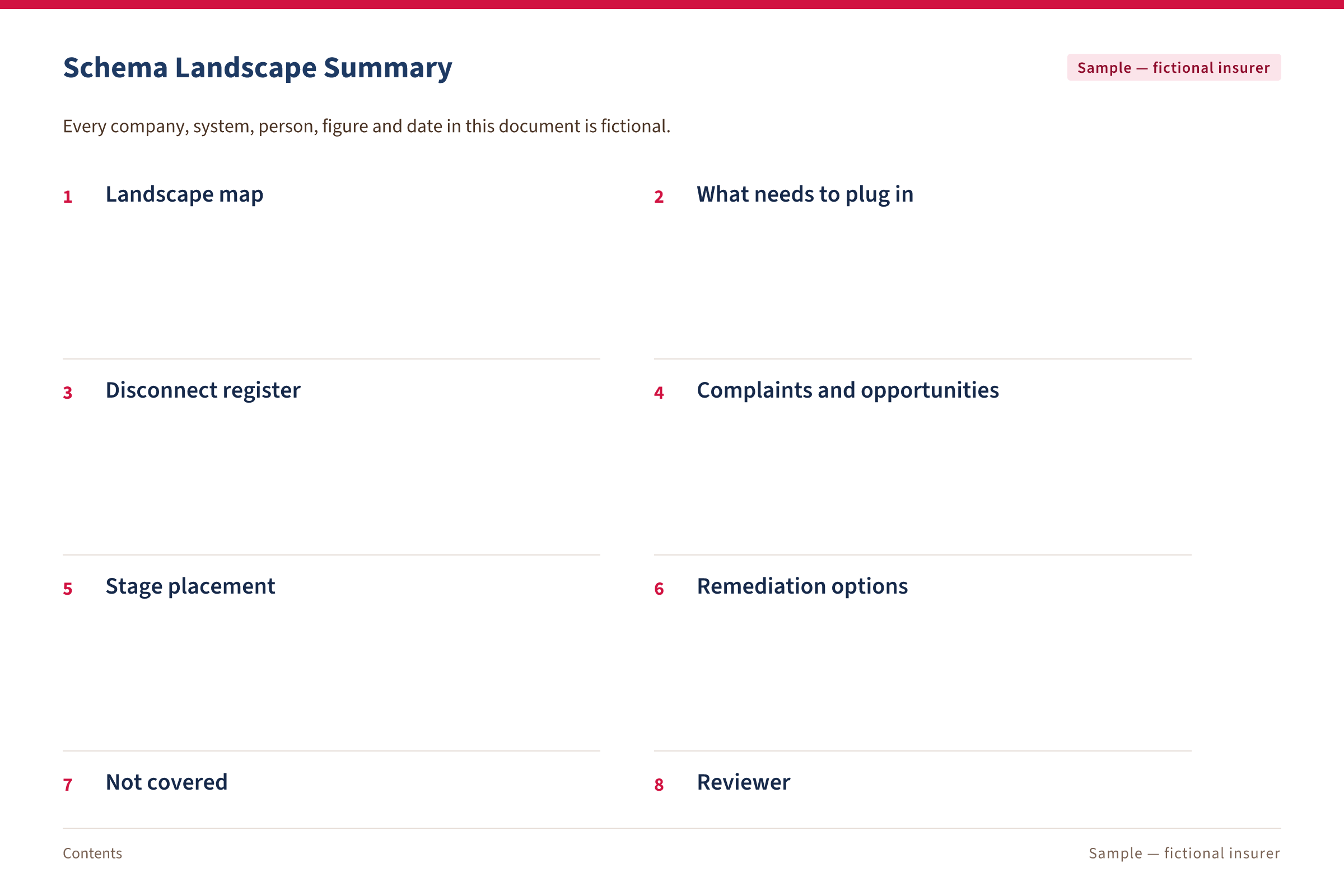
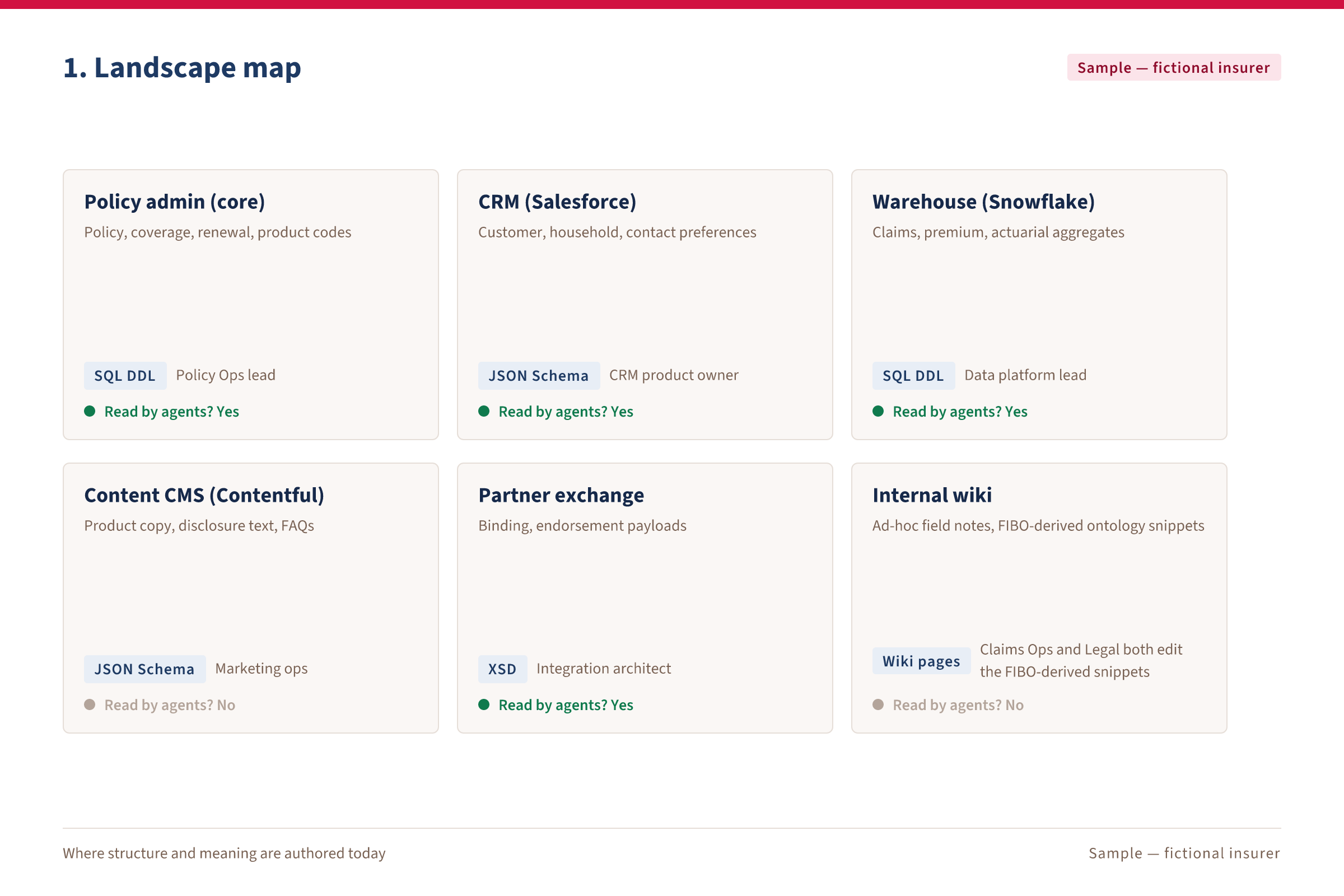
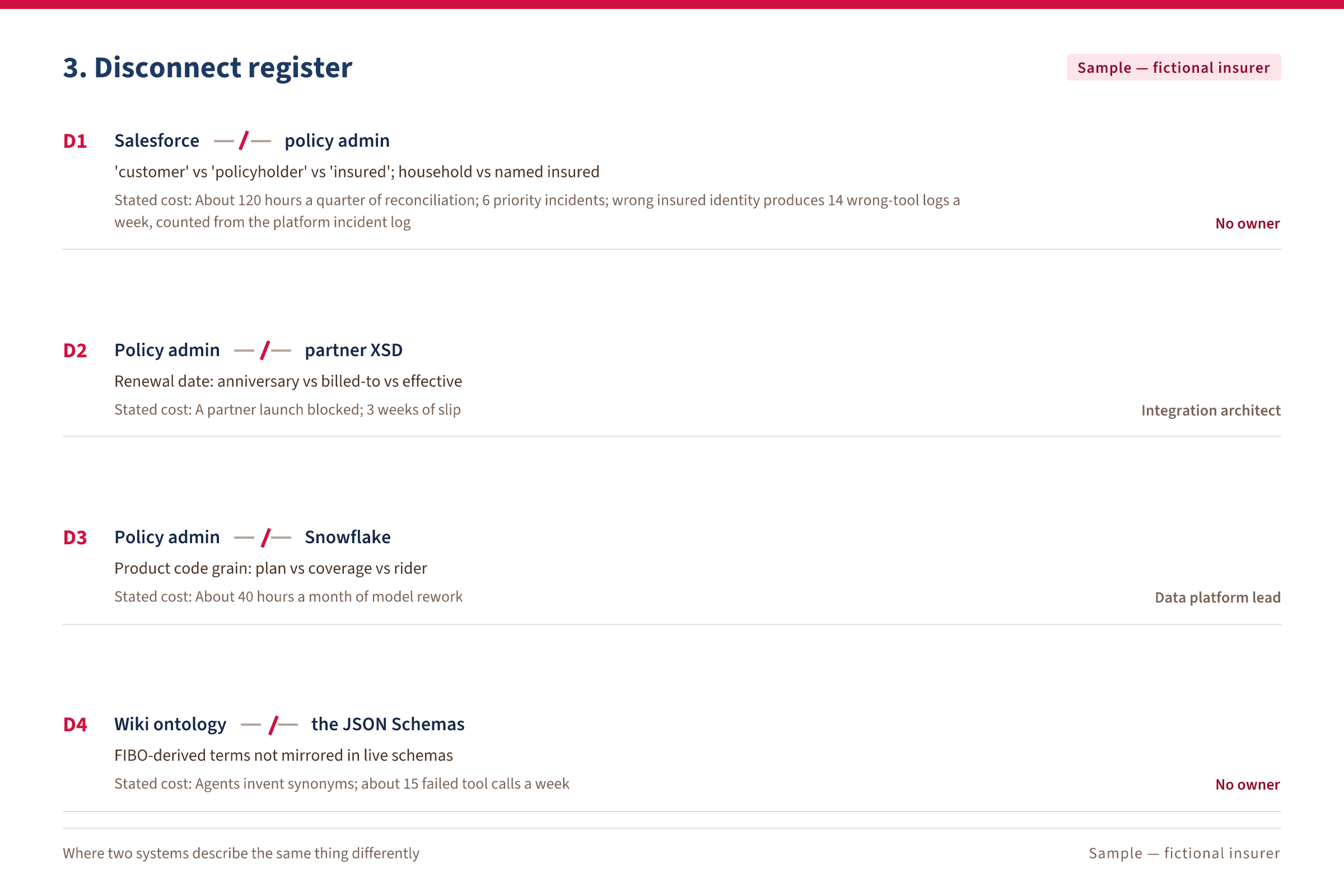
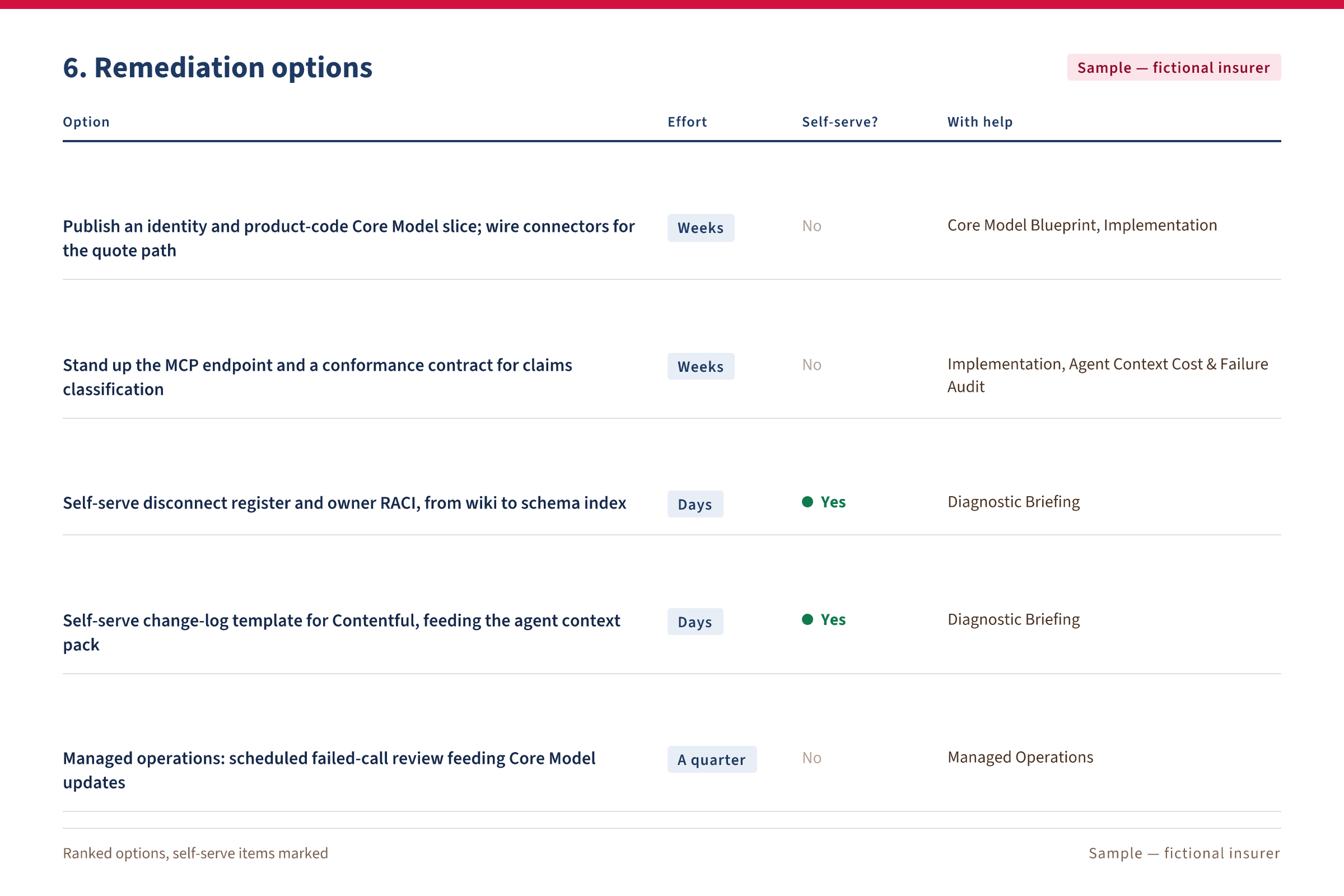
Sample Schema Landscape Summary, fictional insurer — cover, Contents: the eight sections of the written map.Sample Schema Landscape Summary, fictional insurer — section 1, Landscape map: the systems, the format each holds, and which ones agents read.Sample Schema Landscape Summary, fictional insurer — section 3, Disconnect register: where two systems describe the same thing differently, and the cost each owner stated.Sample Schema Landscape Summary, fictional insurer — section 6, Remediation options: ranked options with effort, the self-serve ones marked.
The same eight sections your map will have — every system, cost and name here is invented; the structure is what you get. Read the full sample map

Request an interview